Lead qualification for accounting firms: the questions to ask before the first meeting
A simple qualification framework for CPA, tax and bookkeeping firms: the questions that reveal fit, budget and timing, a scoring sheet, and how to say no politely.
Key takeaways
- Qualification protects partner time: decide who you want to meet before inquiries arrive, not during the call.
- Use five questions: what they need, who they are, how complex it is, when they need it and how they expect to pay.
- Score answers simply (good fit, maybe, not a fit) and route each to the right next step.
- In won sales calls, reps asked about 15 to 16 questions, not 20 or more. Ask fewer, better questions and listen.
In this article
Not every inquiry deserves a partner’s hour. Some prospects want a $100 return when your minimum is $500. Some need a specialist you aren’t. Some will be great clients for years. Lead qualification is how you tell them apart quickly, politely and before the expensive part starts.
This matters more than ever. The Thomson Reuters Institute’s 2026 report found talent shortages and capacity limits among the biggest barriers for tax firms, even as revenue grew (Thomson Reuters). When capacity is scarce, spending it on the right clients is a growth strategy.
Start by defining a good-fit client
Write down, in one paragraph, the client you want more of. For example:
Owner-managed businesses with $500,000 to $10 million in revenue, using cloud accounting software, who want monthly bookkeeping plus year-end tax and are open to planning conversations.
Then write down the deal-breakers: services you don’t offer, fees below your minimum, timelines you can’t meet.
The five qualification questions
1. What do you need help with?
Let them describe it in their own words. Listen for the service and the trigger: “My bookkeeper quit,” “I got a letter from the IRS,” “We’re growing and need advice.”
2. Who are you?
Individual or business? What kind of business, how big and how many entities? This tells you complexity and fit.
3. How complex is it?
Ask a few targeted questions for the service:
| Service | Useful questions |
|---|---|
| Individual return | Self-employed income? Rental properties? Multiple states? |
| Business return | Entity type? Number of owners? Books up to date? |
| Bookkeeping | Monthly transactions? Software used? How far behind? |
| Advisory | What decision are you facing? Who else is involved? |
4. When do you need it?
Deadlines decide whether you can help. A business that needs three years of catch-up bookkeeping in two weeks is a different project from one starting fresh next month.
5. How do you expect to pay?
Share your typical range and ask if it fits: “Monthly bookkeeping for a business your size usually starts around $X. Does that match what you had in mind?” This avoids awkward surprises later.
Ask fewer, better questions
More questions don’t mean better qualification. Gong’s analysis of 326,000 sales calls found that won deals averaged 15 to 16 questions per call, while lost deals averaged about 20, and that winning reps talked less, around 57% of the time versus 62% in lost deals (Gong). The lesson is to ask open questions, then listen.
Score and route every inquiry
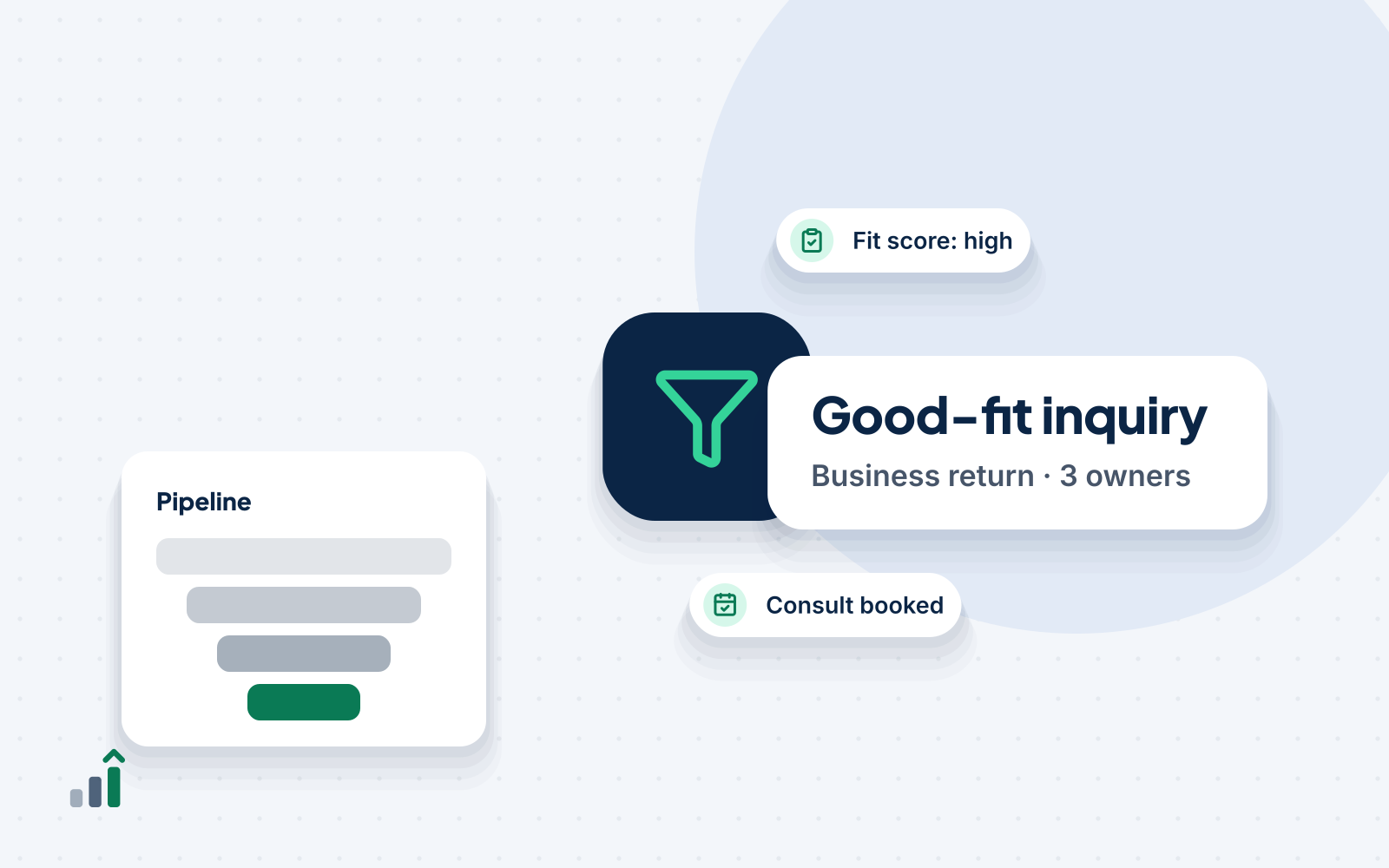
Use a simple three-level score:
| Score | What it means | Next step |
|---|---|---|
| Good fit | Service, size, timing and budget match | Book a consultation with the right person this week |
| Maybe | One question mark, such as timing or scope | Short follow-up call or ask for more information |
| Not a fit | Service you don’t offer, or far below your minimum | Polite no, with a helpful referral |
Write the routing rules down so anyone answering inquiries can apply them consistently.
Qualify fast, or you lose the good ones too
Qualification must not slow you down. Firms that tried to reach a lead within an hour were nearly 7 times more likely to qualify it (HBR). The ideal flow is a short form, an instant acknowledgment, a five-minute call to qualify and a booked consultation for good fits.
How to say no without burning bridges
A clear, friendly no builds your reputation:
Thanks for reaching out. Based on what you’ve told me, we’re not the best fit for this. We focus on [service] for [client type]. For a simple return like yours, [option] would likely be quicker and less expensive. If your situation changes, we’d be glad to help.
Look for advisory signals
ClearlyRated’s 2026 research found 91% of accounting clients want proactive advice from their firm (ClearlyRated). During qualification, note signs of advisory potential: growth plans, a business sale, new hires, cash-flow worries. Those prospects are often worth more than the first engagement suggests.
What to do this week
- Write your good-fit client paragraph and your deal-breakers.
- Turn the five questions into a one-page call guide.
- Add two or three qualifying fields to your contact form, no more.
- Agree on the scoring and routing rules with your team.
- Review last month’s inquiries: how many would have been good fits?
Sources
How we write our insights
Written by the InventaxAI Editorial Team, the people who build websites, run lead follow-up and plan retention campaigns for finance and tax firms. Every number links to its original source, and we don’t invent statistics, case studies or reviews. Last reviewed .
This article is general information, not legal, tax or financial advice. Marketing and contact rules differ by country and profession, so check the rules that apply to your firm.